



Solving Polynomials
Purplemath
The general technique for solving bigger-than-quadratic polynomials is pretty straightforward, but the process can be time-consuming.
Note: The terminology for this topic is often used carelessly. Technically, one "solves" an equation, such as "(polynomal) equals (zero)"; one "finds the roots" of a function, such as "(y) equals (polynomial)". On this page, regardless of how the topic is framed, the point will be to find all of the solutions to "(polynomial) equals (zero)", even if the question is stated differently, such as "Find the roots of (y) equals (polynomial)".

The first step in finding the solutions of (that is, the x-intercepts of, plus any complex-valued roots of) a given polynomial function is to apply the Rational Roots Test to the polynomial's leading coefficient and constant term, in order to get a list of values that might possibly be solutions to the related polynomial equation. Your hand-in work is probably expected to contain this list, so write this out neatly.
You can follow this up with an application of Descartes' Rule of Signs, if you like, to narrow down which possible zeroes might be best to check. On the other hand, if you've got a graphing calculator you can use, it's easy to do a graph. The x-intercepts of the graph are the same as the (real-valued) zeroes of the equation. Seeing where the line looks as though it crosses the x-axis can quickly narrow down your list of possible zeroes that you'll want first to check.
Once you've found an x-value that you want to test, you then use synthetic division to see if you can get a zero remainder. If you do get a zero remainder, then you've not only found a zero of the original polynomial, but you've also reduced your polynomial by one degree, by effectively removing one factor.
Remember that synthetic division is, among other things, a form of polynomial division, so checking if x = a is a solution to "(polynomial) equals (zero)" is the same as dividing the linear factor x − a out of the related polynomial function "(y) equals (polynomial)".
This also means that, after a successful division, you've also successfully taken a factor out. You should not then return to the original polynomial for your next computation for finding the other zeroes. You should instead work with the output of the synthetic division. It's smaller, so it's easier to work with.
(This method will be demonstrated in the examples below.)
You should not be surprised to see some complicated solutions to your polynomials (that is, solutions containing square roots or complex numbers, or both); these zeroes will come from applying the Quadratic Formula to (what is usually) the final (quadratic) factor of your polynomial. You should expect that the answers will be messy.
Here's how the process plays out in practice:
-
Find all the zeroes of: y = 2x5 + 3x4 − 30x3 − 57x2 − 2x + 24
First, I'll apply the Rational Roots Test—
Wait. Actually, the first thing I'll do is apply a trick I've learned. First, I'll check to see if either x = 1 or x = −1 is a root.
(These are the simplest roots to test for. This isn't an "official" first step, but it can often be a timesaver, because (a) it's amazing how often one of these is a zero, and (b) you can just look at the powers and the numbers to figure out if either works, because of how 1 and −1 simplify.)
When x = 1, the polynomial evaluates as:
2 + 3 − 30 − 57 − 2 + 24 = −60
This isn't equal to zero, so x = 1 isn't a root. But when x = −1, I get:
−2 + 3 + 30 − 57 + 2 + 24 = 0
This time, it did equal zero, so now I know that x = −1 is a root, and I can take "prove" this (in my hand-in work) by using synthetic division:
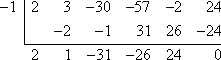
The last line of this division shows me with the new, smaller polynomial equation I'm working with now:
2x4 + x3 − 31x2 − 26x + 24 = 0
(I'd started with a degree-five polynomial. Since I've effectively divided out the factor x + 1, I've reduced the degree of the polynomial by 1. That's how I know the last line of the division represents a degree-four polynomial.)
I've taken care of checking the two easiest zeroes. Now I'll apply the Rational Roots Test to what's left in order to get a list of potential zeroes to try:

From experience (mostly by having worked extra homework problems), I've learned that most of these exercises have their zeroes somewhere near the middle of the list, rather than at the extremes. This isn't always true, of course, but it's usually better to stay away from the larger numbers, at least when I'm getting started.
So, in this case, I won't start off by trying stuff like x = −24 or x = 12. Instead, I'll start out with smaller values like x = 2.
And I can narrow down my options further by "cheating" and looking at the graph:
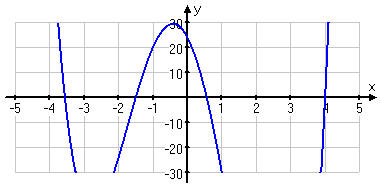
This is a fourth-degree polynomial, so it has, at most, four x-intercepts, and I can see all four of them on the graph. This means that I won't have any complex-valued zeroes.
It looks like one of the zeroes is around −3.5, but isn't on the list that the Rational Roots Test gave me, so this must be an irrational root. I'll leave it until the end, when I'll be applying the Quadratic Formula.
It also looks like there may be zeroes near −1.5 and 0.5. But the clearest solution looks to be at x = 4 and since whole numbers are easier to work with than fractions, x = 4 would probably be a good next value to try:
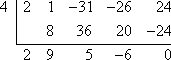
The zero remainder (at the far right of the bottom row) tells me that x = 4 is indeed a root. And the bottom row of the synthetic division tells me that I'm now left with solving the following:
2x3 + 9x2 + 5x − 6 = 0
Looking at the constant term "6" in the polynomial above, and with the Rational Roots Test in mind, I can see that the following values:
x = ±24, ±12, ±8, −4
...from my original application of the Rational Roots Test won't work for the current polynomial. Even if I didn't already know this from having checked the graph, I can see that they won't fit with the new polynomial's leading coefficient and constant term. So I can cross these values off of my list now.
(Always check the list of possible zeroes as you go. The Rational Roots Test will sometimes give a very long list of possibilities, and it can be helpful to notice that some of those values can be ignored, especially if you don't have a graphing calculator to "cheat" with.)

Comparing the remaining values from the list with the intercepts on the graph, I'll try :
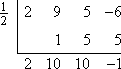
The remainder isn't zero, so that test root didn't work. This means that the zero close to on the graph must be irrational. I'll find it when I apply the Quadratic Formula later on.
For now, I'll try :
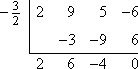
The division came out evenly (that is, it had a zero remainder), so is another of the zeroes. And after this division, I'm now left with the following polynomial equation still to solve:
2x2 + 6x − 4 = 0
Dividing through by 2 to get smaller numbers gives me:
x2 + 3x − 2 = 0
I can apply the Quadratic Formula to this:
![x = [−3 ± sqrt(17)]/2, or about −3.5 and 0.5](polysolv/solve06.gif)
This gives me the remaining two roots of the original polynomial function. (I plugged the exact values into my calculator, to confirm that they match up with what I'd already seen on the graph, so I'd be certain that my answer was correct. I won't hand in these approximations, though.)
My complete answer is:
![x = −1, [−3 ± sqrt(17)]/2, −3/2, 4](polysolv/solve08.gif)
Asking you to find the zeroes of a polynomial function, y equals (polynomial), means the same thing as asking you to find the solutions to a polynomial equation, (polynomial) equals (zero). The zeroes of a polynomial are the values of x that make the polynomial equal to zero. Either task may be referred to as "solving the polynomial".
So the above problem could have been stated along the lines of:
Find the solutions to 2x5 + 3x4 − 30x3 − 57x2 − 2x + 24 = 0
...or:
Find the solutions to 2x5 + 3x4 − 30x3 − 57x2 − 2x = −24
...and the answers would have been the exact same list of x-values.
© 2024 Purplemath, Inc. All right reserved. Web Design by 