



Plotting Points in the Cartesian Plane
Purplemath
When you were trying to find your street on that map, you went over to D and then down to 12. And that "D12" designation was unambiguous, because it was easy to tell which signifier stood for which direction (since letters were across the top and numbers were along the left side).
Even if the designation had been written as "12-D", you still would have known which box to go to, because the "D" would still have been across the top and the "12" would still have been along the side. But in the Cartesian plane, both axes are labelled with numbers. How can you tell how far left or right to go, or how far up or down to go?
How do you plot points?
Given a point, (a, b), you plot the point in the Cartesian plane by finding the number a on the horizontal, or x-, axis; then you trace directly up or down from that spot, moving parallel to the vertical, or y-, axis, until you reach the height of the number b. This spot is the location of the point (a, b).
What are coordinates?
Coordinates are the numbers in a point's name. For instance, the point (−3, 4) has x-coordinate −3 and y-coordinate 4. The x-coordinate is the first coordinate; the y-coordinate is the second coordinate.
For example, suppose you were told to locate "(5, 2)" (pronounced as "the point five two" or just "five two") on the plane. Where would you look? To understand the meaning of "(5, 2)", you have to know the following rule: The x-coordinate (that is, the number for the x-axis) always comes first. The first number (called "the first coordinate") is always on the horizontal axis.
So, for the point (5, 2), you would start at the origin (that is, you'd start at the spot where the two axes cross):
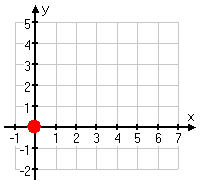
...then count over to "five" on the x-axis:
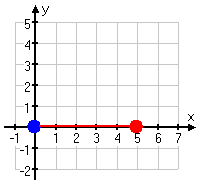
...then count up to "two", moving parallel to the y-axis:
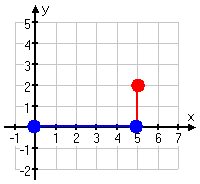
...and then draw in the dot:
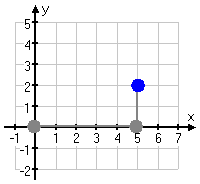
Finding the location of the point (5, 2), and then drawing its dot is called "plotting the point (5, 2)". The drawing of the little part of the x,y-plane, the axes, and the point is what they're expecting for your hand-in answer.
(Labelling the point with its coordinates [which, no, I didn't do above] never hurts, expecially if you've got one of the stricter instructors.
When plotting, remember that the first number is for the horizontal axis and the second number is for the vertical axis. You always go "so far over or back" and then "so far up or down".
- Plot the point (4, −5).
I will start at the origin:
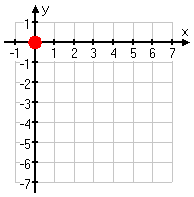
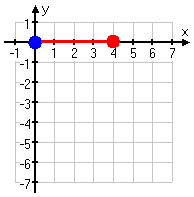
...then I'll count over four units on the horizontal x-axis:
...then I'll count down five units paralell to the y-axis:
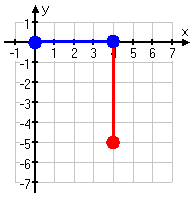
...and then I'll draw my dot:
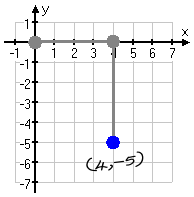
As you can see above, a negative y-coordinate means that you'll be counting down the y-axis, not up; you'll be going below the horizontal axis, not above.
(And, this time, I did label the point. Unless specified by the instructions, this won't be required. If you're feeling a need for brownie points, it wouldn't hurt.)

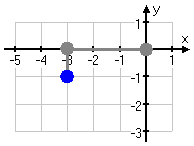
- Plot the point (−3, −1).
I'll start at the origin:
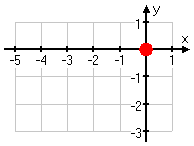
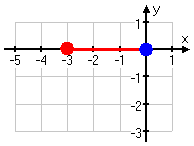
...then I'll count backwards three units along the x-axis:
...then I'll count down one unit parallel to the y-axis:
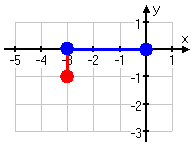
...and then I'll draw my dot:
In summary, to plot a given point (a, b):
- Draw and label a *neat* axis system (that is, use a ruler to draw and label the two perpendicular number lines).
- Locate the origin (that is, start at the point (0, 0) where the two axes cross).
- Move to the right by a units — or, if the number a is negative, move to the left |a| units.
- From this spot on the x-axis (that is, from this spot on the horizontal number line), move upward b units — or downward by |b|, if b itself is negative — always moving parallel to the y-axis (that is, parallel to the vertical number line).
- Draw a dot at your final spot; this is your plotted point.
Note: If you're wanting consistently to receive full credit for your plots, make sure that you're using a ruler to draw your lines and mark your scales — that is, draw evenly-spaced little tick-marks and label at least some of those marks with numbers, so your meaning is clear — and make sure that you draw your dot where it belongs. Don't draw a dot in the general vicinity, and then draw a huge dot to "include" both the first dot and the location where that dot *should* have gone in the first place.
© 2024 Purplemath, Inc. All right reserved. Web Design by 